Reducing Decision Friction in Premium Online Catering
Research-Led Website Redesign for a Growing Local Catering Business
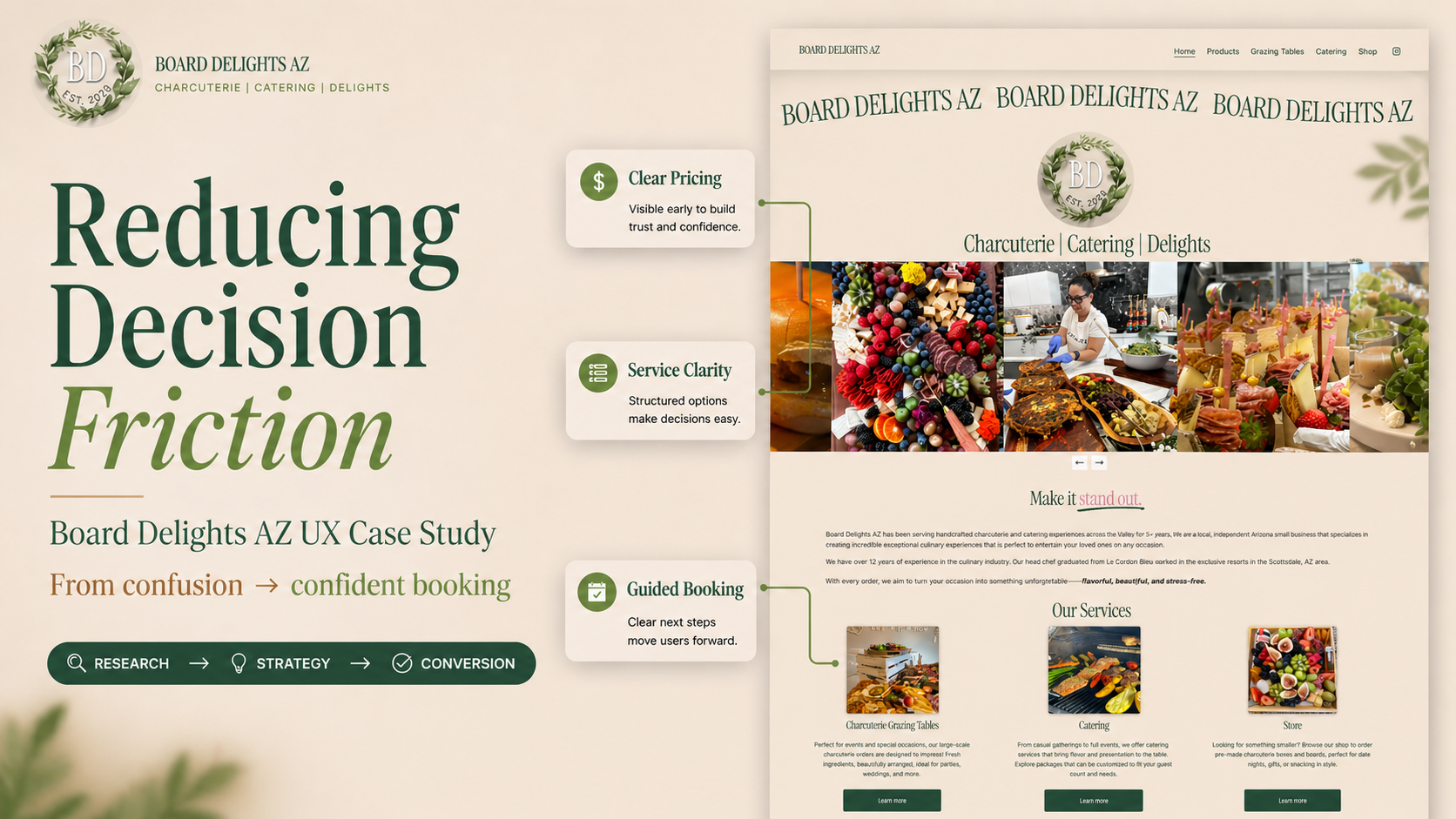
Context
A local favorite scaling from social media to structured booking.
Board Delights AZ is a local charcuterie caterer scaling for growth. As demand increased, the business needed to bridge the gap between social media interest and structured booking while elevating brand value.
Goal: Bridge the gap between social media interest and final booking.
The Problem
Users were ready to buy but couldn't quickly figure out how.
Potential customers arrived with intent but encountered friction that stopped momentum. Instead of booking, users were forced to search or ask for clarification.
Sticking Points:
- Hidden pricing
- Unclear and poorly differentiated services
- Ambiguous paths or next steps
Why it mattered:
Lower booking confidence and higher drop-off rates.
Research Objectives
Research focused on four key friction points:
What information helps users quickly assess value?
What reduces hesitation before committing?
How users judge quality and trust in a catering service?
What makes next steps clear and actionable?
Research Approach & Constraints
- Business perspective → What issues were recurring?
- Customer behavior → What were users actually asking and struggling with?
- Experience evaluation → Where did the interface create friction?
Stakeholder Interview
Participant: Business Owner
Purpose:
Understand operational challenges, recurring customer questions, and brand positioning goals.
Customer Conversations
Analysis of customer inquiries (Instagram DMs, In-person conversations & email threads)
Identified/Revealed:
- FAQ patterns
- Points of confusion
- Service comparison behaviors
Heuristic Evaluation
System Visibility & Consistency
Purpose:
Identify structural friction and trust gaps (e.g., system status visibility, consistency standards).
Competitive Audit
3 Catering Sites Compared
Compared:
Established expectations for pricing visibility, service clarity, and booking flow
Iterative Prototype Testing
3 Iterations
Observed how users:
- Found pricing
- Selected appropriate service
- Determined next steps
Pilot Validation
Real-world usage
Outcome:
Confirmed users could complete tasks without needing clarification
Research Constraints: Limited participant access, Capstone timeline, Small business data limitations. (Prioritized high-signal insights over large sample size)
Synthesis Process
User friction occurred at three predictable stages in the decision journey.
Breakdown stages:
1. Value Assessment: “Is this worth it?”
Users struggled to:
- locate pricing
- compare service options
This made it difficult to determine whether the service aligned with their expectations and budget.
If users couldn't quickly assess value, they hesitated before moving forward.
2. Trust Formation: “Do I trust this business?”
Visual inconsistencies and lack of structure reduced perceived professionalism.
Users relied on visual clarity and consistency as signals of quality and legitimacy.
3. Action Clarity: “What do I do next?”
Unclear next steps and booking pathways interrupted momentum.
Even when users were interested, they paused or dropped off without clear direction.
Key Findings
Here's why users hesitate and don't convert.
Finding 1: Users use pricing and layout to judge quality
What I observed
- Several users asked "Do you have a price list?" even after browsing
- One user paused and said they would "probably just message the business" instead of continuing
- Visual inconsistencies made the site feel less professional
What this means
Users rely on pricing visibility and visual clarity as quick signals of legitimacy and quality.
Why It Matters
If users can't quickly find pricing or trust the presentation, they hesitate even when interested.
Finding 2: Unclear services slow down decision-making.
What I observed
- Users struggled to distinguish between catering, grazing tables, and XL boards
- Users spent more time comparing options before selecting
- Conversations showed uncertainty about which service fit their needs
What this means
When service options aren't clearly differentiated, it forces users to stop and figure out the differences themselves.
Why it matters
This extra effort slows decisions and increases the chance users give up.
Finding 3: Users lose momentum without clear next steps
What I observed
- Booking pathways were not immediately visible or intuitive
- Users frequently paused or exited the flow instead of choosing a next step
- Some users reached out instead of completing the flow
What this means
Even after deciding, users require immediate direction. Without it, momentum is lost.
Why it matters
Interruptions at this stage prevent users from converting, even when purchase intent is high. Without clear next steps, users drop off at the final stage of decision-making.
Insight → Design
Users decide within seconds whether to stay or leave.
Core Insight
Within the first 10 seconds, users must be able to understand:
• What the business offers
• How services differ
• Where to find pricing (or how much it costs)
• How to move forward
How this shaped design:
Design Decisions
-
Structured product distinctions
Clearly separated catering, grazing tables, and board options to reduce comparison effort and help users quickly identify the right service.
-
Simplified and guided navigation pathways
Made next steps visible and intuitive, allowing users to move from browsing to booking without hesitation.
-
Unified visual system
Applied consistent typography, layout, and spacing to reinforce professionalism and build immediate trust.
-
Content reduction and prioritization
Removed non-essential information to surface key decision-making content (pricing, services, and next steps being within initial view.)
Design Philosophy
This redesign prioritized decision clarity and cognitive ease, ensuring users could quickly understand, evaluate, and act without unnecessary friction or visual distraction.
Validation & Iteration
Design decisions were refined through rapid testing focused on key user tasks.
Each iteration targeted moments where users hesitated—improving how quickly they could find pricing, choose a service, and understand next steps.
Phase 1 — Identifying & Reducing Friction
What happened
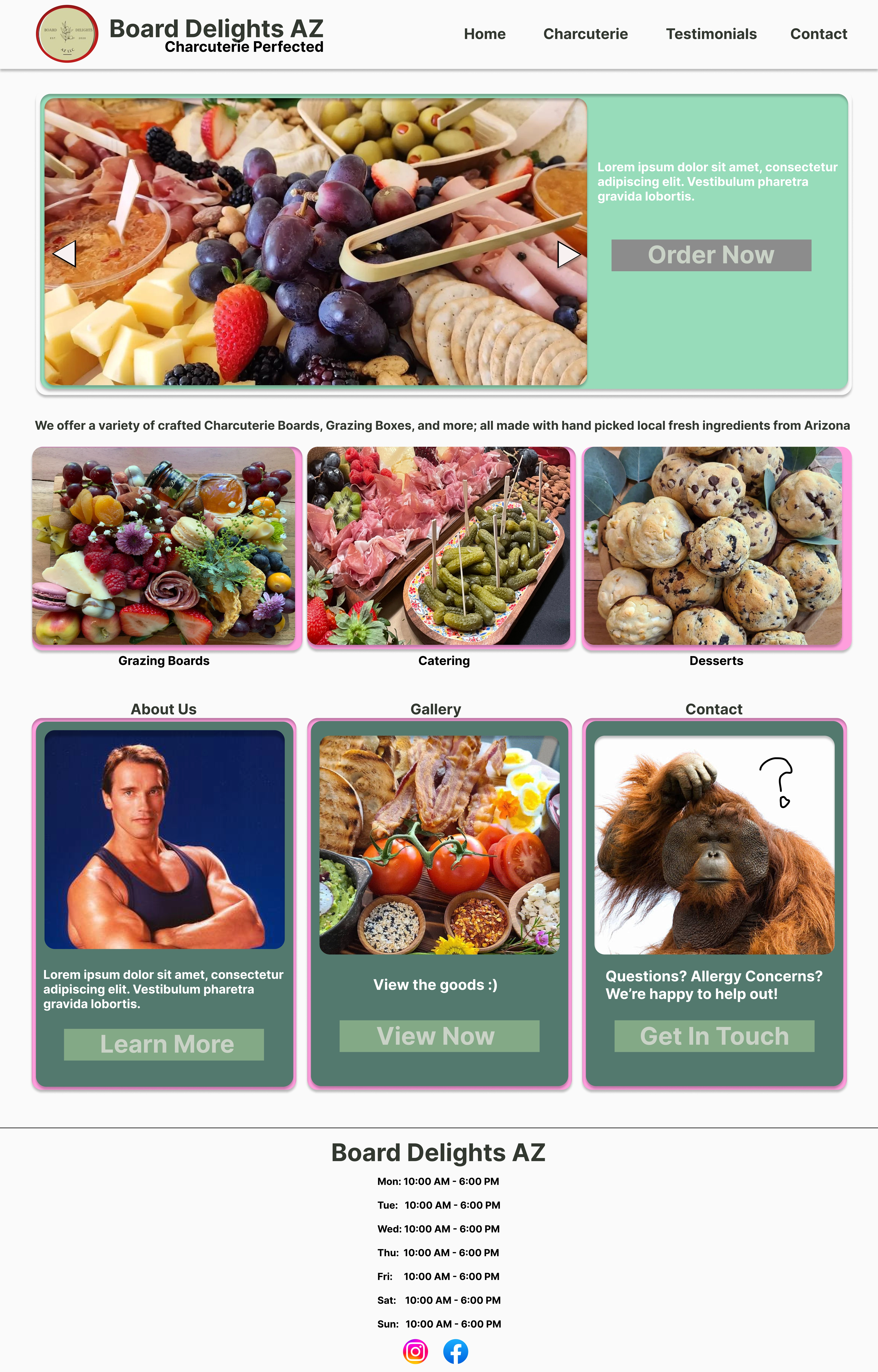
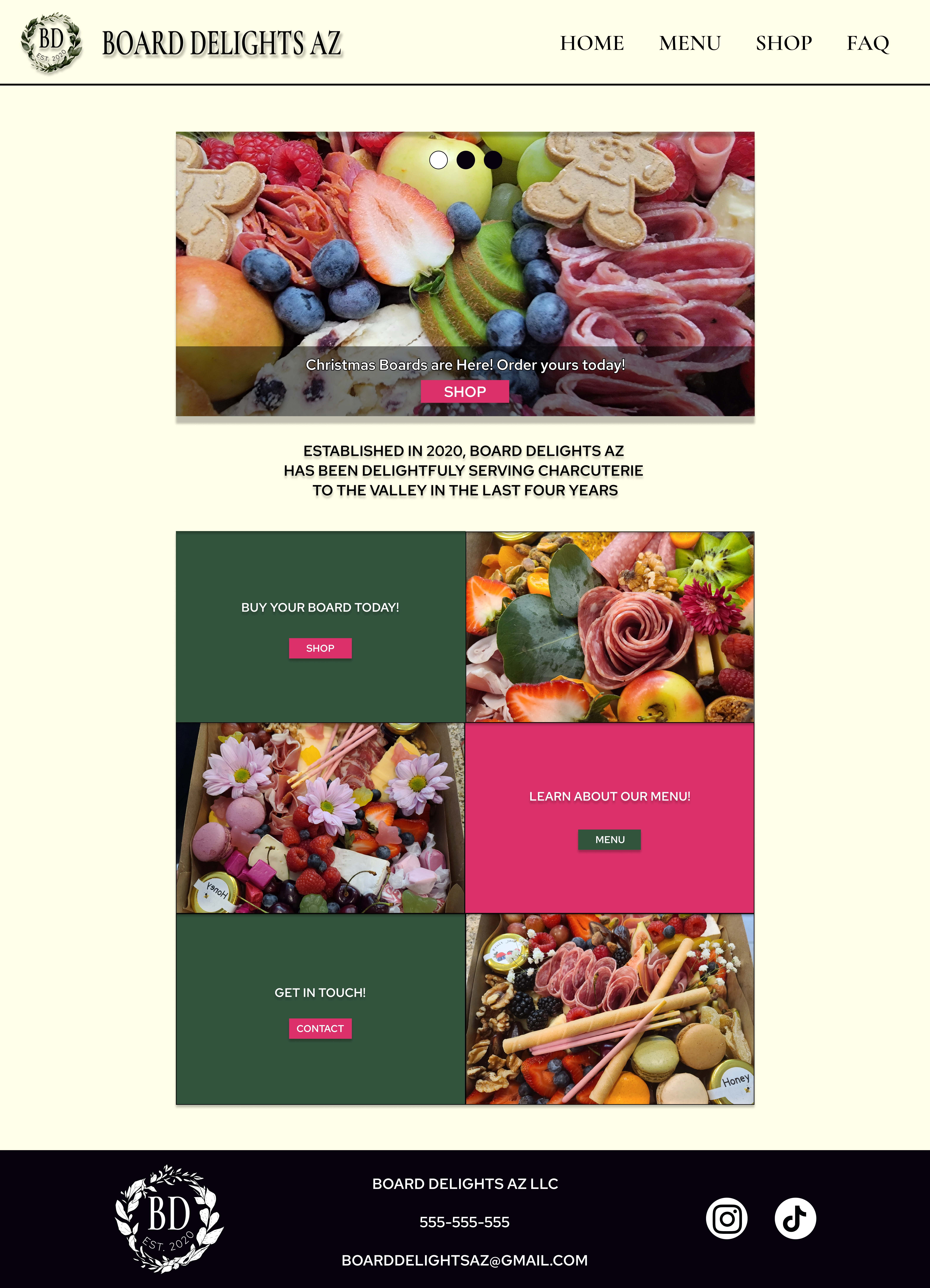
- Users couldn’t quickly find pricing or differentiate between service types.
- Pricing improved, but service comparison remained slow due to visual overload.
Tactical Changes
- Moved pricing higher in the layout and introduced clearer service groupings.
- Strengthened visual hierarchy and reduced competing content to focus attention on key decisions.
Phase 2 — Final Validation
What happened
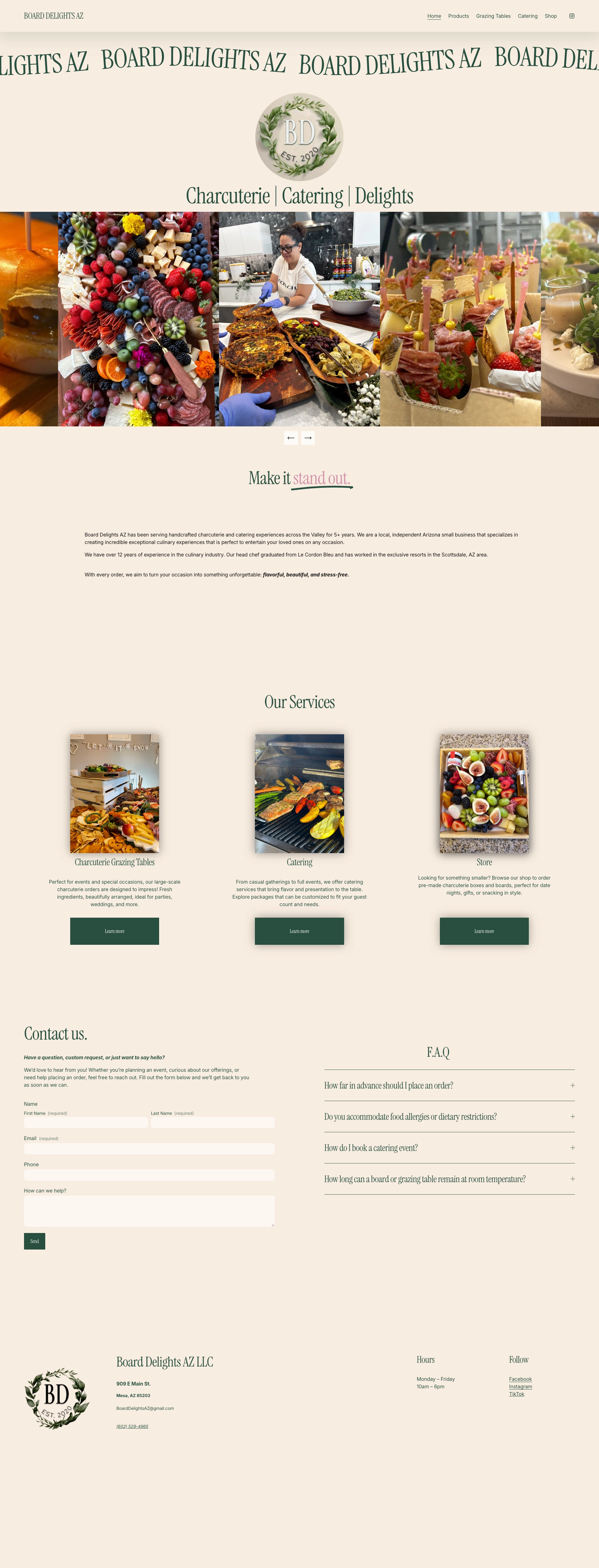
- Users moved quickly through tasks
- Users stopped asking clarification questions
- Decisions felt more immediate and confident
Validated Outcomes
Effortless Search
Users located pricing with minimal searching
Efficient Selection
Users selected services with reduced comparison time
Inherent Trust
Users proceeded without needing clarification
Key takeaway
When critical information was surfaced early and clearly, users stopped hesitating and started deciding. In earlier iterations, users paused to search or asked clarifying questions—by the final iteration, they completed tasks without stopping.
Impact
The redesign shifted the experience from effortful to intuitive decision-making.
Reduced reliance on manual customer support
Users no longer needed to ask common clarification questions (e.g., pricing, service differences), decreasing dependency on DMs and email inquiries.
Faster path from interest to decision
By surfacing key information earlier, users were able to move from browsing to selecting a service without interruption or backtracking.
Improved decision confidence
Clear service distinctions and structured content allowed users to choose options without second-guessing or extended comparison.
Stronger perceived brand credibility
A consistent visual system eliminated early trust concerns, aligning the experience with expectations of a premium service.
Foundation for scalable growth
The structured experience supports additional services and expansion without increasing user confusion or decision complexity.
From Insight → Outcome
Unclear pricing
→ surfaced pricing → faster value assessmentConfusing services
→ structured distinctions → quicker, more confident selectionHidden next steps
→ guided pathways → smoother conversion flowVisual inconsistency
→ unified system → increased trust and credibilityReflection
Focusing on behavior over interface.
Effective UX isn't just providing information; it's about supporting evaluation and commitment. This project strengthened my ability to identify patterns and act on behavioral data.
Next Steps:
- Validate with larger sample size
- Introduce measurable usability metrics
- Formalize synthesis via affinity mapping